Best Lightweight Travel Trailers (2026): What Your Vehicle Can Actually Tow
The best lightweight travel trailers for 2026, matched to real tow capacity: weight-classed picks under 2,000 to 5,000 lbs, plus tongue weight and payload math.

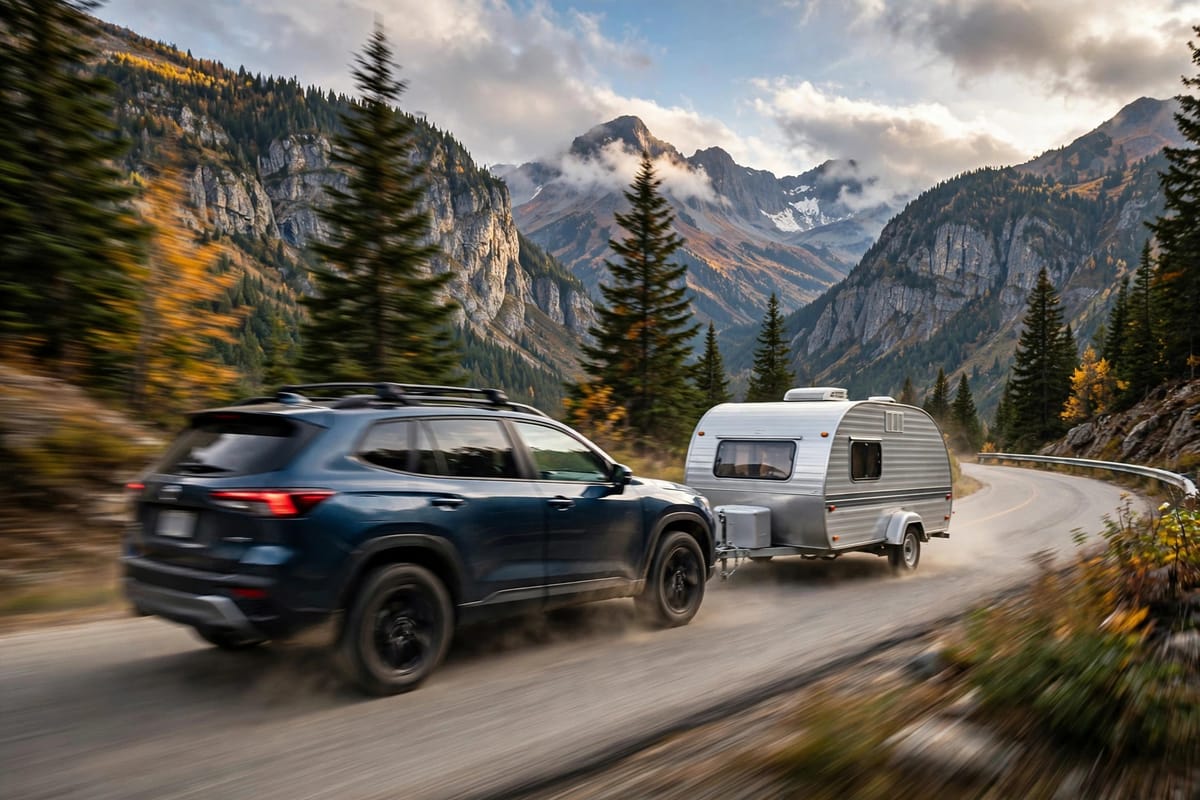
Every list of the best lightweight travel trailers shows you floor plans and features. Almost none answers the question that actually matters: can your vehicle tow it — safely, legally, and without white knuckles?
This guide is different. First, the tow-capacity math most buyers get wrong: dry weight vs GVWR, tongue weight and payload, and why your tow rating isn't the whole story. Then, weight-classed picks — under 2,000 lbs, 2,000–3,500 lbs, and 3,500–5,000 lbs — with example tow vehicles for each class. Once you know your real numbers, browse lightweight travel trailers on RV Matcher and shop with confidence.
Tow-Capacity Math: Dry Weight vs GVWR vs Reality
Trailer listings shout about dry weight (unloaded vehicle weight) because it's the smallest, most attractive number. It's also the least useful. Nobody tows a dry trailer — you tow it loaded with water, propane, batteries, food, clothes, and gear.
The number that matters is GVWR (Gross Vehicle Weight Rating): the maximum the trailer can weigh fully loaded. Smart buyers shop against GVWR, because that's the weight you'll actually tow on a real trip.
Here's the math that keeps you safe:
- Find your vehicle's tow rating (owner's manual or door sticker — not the commercial).
- Stay under 80% of it. That 20% margin covers mountains, headwinds, and the fact that manufacturer tow ratings assume ideal conditions with only a driver aboard.
- Compare against the trailer's GVWR, not its dry weight. If the GVWR exceeds 80% of your tow rating, it's too much trailer.
Example: your SUV is rated to tow 5,000 lbs. Your safe target is ~4,000 lbs. A trailer with a 3,200-lb dry weight but a 4,500-lb GVWR is over your safe limit — even though the "dry weight" looked fine. This single mistake accounts for most overloaded setups on the road.
Tongue Weight and Payload: The Number People Forget
Here's the spec that ruins more camping trips than any other: payload capacity — how much weight your tow vehicle itself can carry, including passengers, cargo, and the trailer's tongue weight pressing down on the hitch.
Travel trailer tongue weight typically runs 10–15% of the loaded trailer weight. A 4,000-lb loaded trailer puts 400–600 lbs on your hitch. That comes straight out of your vehicle's payload, which also has to cover:
- You, your passengers, and the dog
- Everything in the cargo area and truck bed
- The weight-distribution hitch itself (~75–100 lbs)
Check the payload number on your driver's door jamb sticker (not the brochure — options eat payload). Many midsize SUVs have just 1,000–1,200 lbs of payload. Four adults plus gear plus 500 lbs of tongue weight can max that out before you've loaded a single cooler.
The rule: payload runs out before tow rating on most SUVs and half-tons. Do the payload math first — it's the stricter limit more often than buyers expect.
Why Your Tow Rating Isn't the Whole Story
Manufacturer tow ratings are calculated under controlled conditions: flat ground, a single 150-lb driver, no cargo. Real towing adds:
- Passengers and cargo reduce available capacity pound for pound.
- Hills and altitude sap power — naturally aspirated engines lose roughly 3% of power per 1,000 feet of elevation.
- Wind turns a tall trailer into a sail. A lightweight trailer with a big frontal area can be harder to tow than a heavier, lower one.
- Wheelbase matters. Short-wheelbase tow vehicles are more susceptible to trailer sway. A weight-distribution hitch with sway control isn't optional on marginal setups — it's essential safety equipment.
None of this means you need a bigger truck. It means you need honest numbers and the right hitch setup. A well-matched 3,500-lb trailer tows better than a marginal 5,000-lb one, every time.
For the full ownership budget — trailer, hitch, brake controller, insurance — see our RV cost guide.
Best Lightweight Travel Trailers Under 2,000 lbs
This is the "tow it with what you have" class — many crossovers and even some cars (with proper ratings) can handle these.
Trailers in this class are typically 13–17 feet, sleep 2–3, and keep things simple: a bed, a basic kitchen, and often a wet bath or none at all. Fiberglass "egg" trailers dominate the reputation chart here — brands like Casita, Scamp, and Oliver have cult followings for their durability and resale value. These molded-fiberglass shells resist leaks far better than conventional stick-built walls, which is why decade-old eggs still command strong prices.
Also worth a look: the Airstream Basecamp, which brings Airstream build quality to a compact, off-grid-friendly package, and teardrop-style trailers for minimalist campers.
Example tow vehicles: Subaru Outback, Honda Passport, Toyota Highlander, Ford Escape (check individual ratings — not all trims qualify).
Best Lightweight Travel Trailers: 2,000–3,500 lbs
The sweet spot for small families and midsize SUVs. These 17–22-foot trailers sleep 3–5 and offer real bathrooms, full kitchens, and slide-outs on some models.
Jayco Jay Feather and Forest River R-Pod lines have strong reputations in this class — light enough for properly equipped midsize SUVs, with floor plans that don't feel like compromises. The Airstream Bambi brings iconic build quality to the lightweight segment (at a premium), and Winnebago Micro Minnie earns consistent owner praise for thoughtful design at reasonable weights.
Watch the GVWR carefully in this class — it's easy to find a "3,000-lb" trailer with a 4,500-lb GVWR that pushes past a midsize SUV's safe limit once loaded.
Example tow vehicles: Jeep Grand Cherokee, Toyota 4Runner, Ford Explorer, Honda Ridgeline, Chevrolet Colorado.
Best Lightweight Travel Trailers: 3,500–5,000 lbs
Now you're in half-ton and full-size SUV territory — 22–26-foot trailers with bunkhouses, bigger tanks, and room for the whole crew.
Grand Design Imagine XLS, Keystone Passport, and Jayco Jay Flight SLX are the most-recommended names here, balancing family-friendly floor plans against weights a half-ton truck handles comfortably. These lines have earned their reputations through strong dealer networks and owner satisfaction — see our broader travel trailer brand guide for the full picture.
At this weight, a weight-distribution hitch with integrated sway control is non-negotiable, and a brake controller is legally required in most states. Budget for both if your setup doesn't include them.
Example tow vehicles: Ford F-150, Ram 1500, Chevrolet Silverado 1500, Toyota Sequoia, Nissan Armada.
Tow Vehicle Match Table
| Trailer Class | Loaded Weight Target | Example Tow Vehicles | Hitch Essentials |
|---|---|---|---|
| Under 2,000 lbs | ≤ 2,000 lbs GVWR | Subaru Outback, Honda Passport, Toyota Highlander | Sway control recommended |
| 2,000–3,500 lbs | ≤ 3,500 lbs GVWR | Jeep Grand Cherokee, Ford Explorer, Honda Ridgeline | Weight-distribution + sway control |
| 3,500–5,000 lbs | ≤ 5,000 lbs GVWR | Ford F-150, Ram 1500, Toyota Sequoia | WD hitch + sway control + brake controller |
Always verify YOUR specific vehicle's ratings — trim, engine, and options change the numbers. The door-jamb stickers beat the brochure every time.
What to Check on a Used Lightweight Trailer
Lightweight trailers get towed by smaller vehicles, which means they're more likely to have been overloaded — and overload damage hides well.
- Frame and axle. Look for bent axles, cracked welds, and sagging. Overloaded lightweight frames tell on themselves here.
- Tires. Check DOT date codes — trailer tires age out in 5–6 years regardless of tread. Mismatched tires suggest deferred maintenance.
- Water damage. Press walls and floors for soft spots, especially around windows, the roof edge, and the bathroom. Lightweight construction leaves less margin for rot.
- Appliances and systems. Run everything — fridge on both modes, water pump, water heater, furnace, A/C. Lightweight trailers often have smaller tanks and simpler systems; make sure they all work.
- Weight honesty. Ask the seller for the actual loaded weight if they know it, and verify the GVWR sticker. Our RV inspection checklist covers the complete walkthrough.
Buying from a private seller? Our guide to buying from a private seller safely covers payment, title, and scam avoidance.
What is considered a lightweight travel trailer?
Can a midsize SUV tow a travel trailer?
What is the 80% towing rule?
Do I need a weight-distribution hitch for a lightweight trailer?
Are lightweight travel trailers less durable?
Match Your Vehicle to the Right Trailer
Now you know the math — and that's the hard part. Browse lightweight travel trailers on RV Matcher, filter by what your vehicle can actually tow, and check recently sold prices to make sure you're paying fairly. The right trailer at the right weight means relaxed miles instead of white knuckles.