Selling Your RV: Facebook Marketplace vs. a Dedicated RV Marketplace
Should you sell your RV on Facebook Marketplace or a dedicated RV marketplace? An honest 2026 comparison of buyer quality, scams, pricing, and speed — plus safety tips for private sellers.

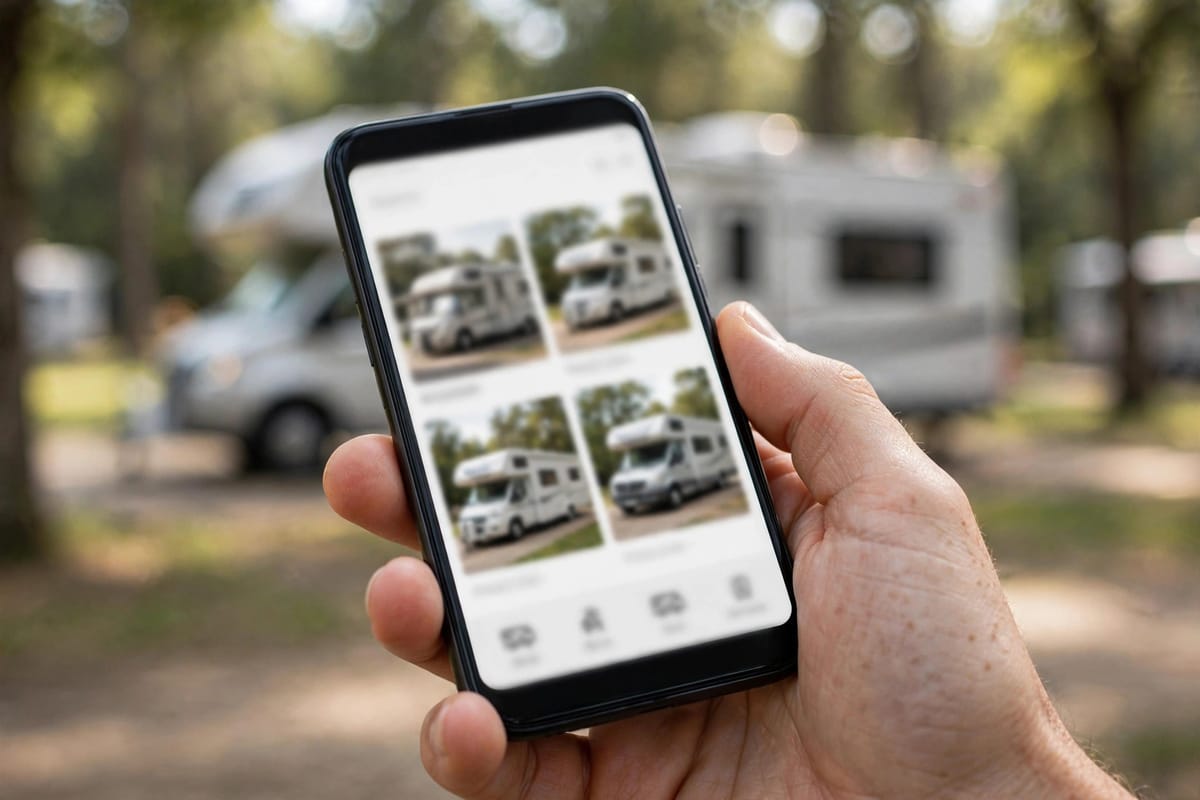
Almost every private RV seller starts in the same place: staring at the Facebook Marketplace "create listing" screen, wondering if it's really the best way to sell a $20,000–$100,000 vehicle. It's free, it's familiar, and everyone you know is already on Facebook. So why do so many sellers end up frustrated — and where do the serious buyers actually go?
This is the honest, head-to-head comparison: Facebook Marketplace vs. a dedicated RV marketplace. Buyer quality, sale price, speed, scams, effort — everything that actually determines how your sale goes. By the end, you'll know exactly which one fits your situation (spoiler: for many sellers, the answer is both, used strategically).
The Head-to-Head Comparison
| Factor | Facebook Marketplace | Dedicated RV Marketplace |
|---|---|---|
| Cost to list | Free | Varies — some charge listing fees, others don't |
| Audience | Everyone local; mostly casual browsers | RV shoppers specifically looking to buy |
| Buyer intent | Low to mixed — lots of curiosity clicks | High — visitors came to shop for an RV |
| Listing tools | Generic: title, price, photos, description | RV-specific: class, length, slides, sleeping capacity, filters |
| Typical inquiries | High volume, many lowballs and no-shows | Lower volume, more serious and informed |
| Sale price achieved | Often below market (bargain-hunter audience) | Closer to market value |
| Time to sell | Can be fast locally — or stall for months | Typically steadier; serious buyers decide faster |
| Scam exposure | High — the #1 platform for vehicle sale scams | Lower — smaller, more focused audience |
| Geographic reach | Primarily local | Local + regional + national |
| Paperwork/pricing support | None — you're on your own | Often includes valuation tools and seller guides |
Neither column is all good or all bad. The question is which set of trade-offs matches your sale.
Where Serious RV Buyers Actually Shop
Here's the dynamic most sellers underestimate: platform shapes buyer behavior. Someone scrolling Facebook between a neighbor's baby photos and a used couch is not in buying mode — your RV is an interruption. Someone who opened an RV marketplace, filtered by Class C under $60,000, and sorted by newest is a buyer with intent and usually a budget.
That doesn't mean Facebook buyers never convert. It means the conversion math is different:
- Facebook Marketplace generates lots of conversations that go nowhere. Expect a meaningful share of messages to be lowball offers ("I'll give you $8k cash today" on a $22,000 trailer), people who can't actually finance or tow what you're selling, and buyers who vanish the moment you suggest a phone call.
- Dedicated RV marketplaces generate fewer inquiries, but each one is far more likely to be real. Buyers arrive with research done, financing lined up, and specific questions about your rig.
One revealing pattern: sellers of higher-value RVs (roughly $30,000+) consistently report better outcomes on RV-specific platforms, while sellers of older budget campers often do fine on Facebook. The more expensive and specialized the RV, the more the audience matters.
The Facebook Marketplace Reality: Lowballs, Scams, and Tire-Kickers
Let's be specific about what "free" actually costs you on Facebook Marketplace:
The lowball economy. A meaningful percentage of Facebook inquiries will be offers far below asking — often 30–50% under. It's not personal; the platform's culture rewards aggressive bargaining. If your price is firm and fair, you'll spend real time filtering.
"Is this still available?" The platform's one-tap inquiry button generates floods of messages from people who clicked without reading. Many never respond to a follow-up.
Scams target high-value listings. RVs are prime scam bait because of the dollar amounts. Watch for: buyers who "accidentally" overpay with a cashier's check and ask you to wire back the difference; buyers who can't talk on the phone or see the RV but want to "reserve" it with a deposit; and anyone pushing the transaction onto unusual payment rails. Never accept personal checks, Venmo, Zelle, or PayPal for an RV sale — they lack the fraud protection a transaction this size demands.
No RV-specific listing fields. You can't filter by what RV buyers actually search: class, length, dry weight, slide count. Your travel trailer competes in the same feed as jet skis and riding mowers, and it disappears from feeds fast.
No pricing or paperwork guidance. You're entirely on your own for valuation, bill of sale, title transfer, and lien payoff.
None of this makes Facebook useless — it makes it a volume play with real costs in time and patience.
The Dedicated RV Marketplace Advantage
A dedicated RV marketplace — RV Matcher, RVT, RV Trader, and similar platforms — is built around one transaction type. That focus shows up everywhere:
- Search that matches how buyers think. Class, length, price range, new vs. used, specific features. Your listing surfaces for exactly the buyer looking for it.
- Self-selecting audience. Nobody browses an RV marketplace by accident. Every view is someone at least considering an RV purchase.
- Better listing presentation. RV-specific fields (sleeping capacity, slide-outs, hitch weight, generator hours) let serious buyers evaluate your rig without twenty back-and-forth messages.
- National reach. A buyer three states away can find your RV as easily as your neighbor can — critical for less common models where the right buyer isn't local.
- Seller resources. Many RV platforms offer pricing tools, photo guidance, and selling guides as part of the experience.
The trade-off: some RV marketplaces charge listing fees or offer paid visibility tiers, and total inquiry volume will be lower than Facebook. You're trading quantity for quality.
Safety Playbook: Selling Your RV Privately on Any Platform
Wherever you list, a private RV sale means meeting strangers around a high-value asset. These rules are non-negotiable:
- Verify payment before signing anything. Cashier's checks get verified with the issuing bank (call the number on the bank's website, not the check). Wires must fully clear — not just "show as pending."
- Meet smart. Show the RV in daylight, in a visible location. Bring someone with you. For high-value rigs, some sellers meet at the buyer's bank so funds can be verified on the spot.
- Never share financial details. No bank logins, no "verification deposits," no overpayment-and-refund schemes — ever.
- Keep communication on-platform until you're serious. Moving to text or email is fine once a buyer is real, but early off-platform contact is a common scam setup.
- Trust the phone-call test. Serious buyers will talk on the phone. Scammers and tire-kickers overwhelmingly won't.
- Document everything. Bill of sale, title transfer, release of liability, and photos of the RV's condition at handover.
For the full private-sale safety walkthrough, see our guide to buying an RV online — the scam patterns are the same from either side of the deal.
When Facebook Marketplace Wins
Facebook is genuinely the better choice when:
- Your RV is priced under roughly $15,000. Budget buyers live on Facebook and Craigslist. The audience match is good at this price point.
- You want a fast local cash sale and will price aggressively to get it.
- You have time and patience to filter dozens of messages to find the real buyer.
- Your RV is a common local model (a standard travel trailer, a pop-up) where the buyer pool is deep nearby.
When a Dedicated RV Marketplace Wins
An RV-specific platform is the better choice when:
- Your RV is worth roughly $20,000 or more. Higher prices demand serious buyers, and that's the RV-marketplace audience.
- You want close to market value, not a quick lowball-driven sale.
- Your RV is unusual — a rare floor plan, a diesel pusher, a well-equipped boondocking rig. The right buyer probably isn't in your zip code.
- The buyer may need financing. Serious financed buyers shop RV platforms, not Facebook feeds.
- You value your time. Fewer, better inquiries beats a flood of noise.
The Strategy Most Successful Sellers Use: Both
Here's what the data and seller experience point to: the highest-performing approach is usually one RV-specific marketplace as your anchor listing, plus Facebook Marketplace for local volume. The anchor listing carries your full photo set, detailed description, and market-correct price for serious buyers. The Facebook listing acts as a local net — priced the same, linking the same details, catching nearby buyers who'd never visit an RV site.
Keep three rules for the dual-listing strategy: identical pricing everywhere (buyers cross-check), the same strong photo set on both, and pull the secondary listing the moment you accept an offer. Done right, you get the best of both audiences without double the work.
Is Facebook Marketplace good for selling an RV?
Do serious RV buyers use Facebook Marketplace?
What are the most common RV sale scams on Facebook Marketplace?
Should I list my RV on multiple websites at the same time?
How do I price my RV competitively for a private sale?
List Where the Serious Buyers Are
Facebook Marketplace has its place — but if you want inquiries from buyers who showed up intending to buy an RV, list where RV shopping is the entire point.
List your RV on RV Matcher — an RV-specific marketplace where your listing reaches motivated buyers, not casual scrollers.