RV Consignment: How It Works, Fees & Is It Worth It?
RV consignment explained: typical dealer commissions, contract red flags, insurance while on the lot, and consignment vs private sale math for 2026.

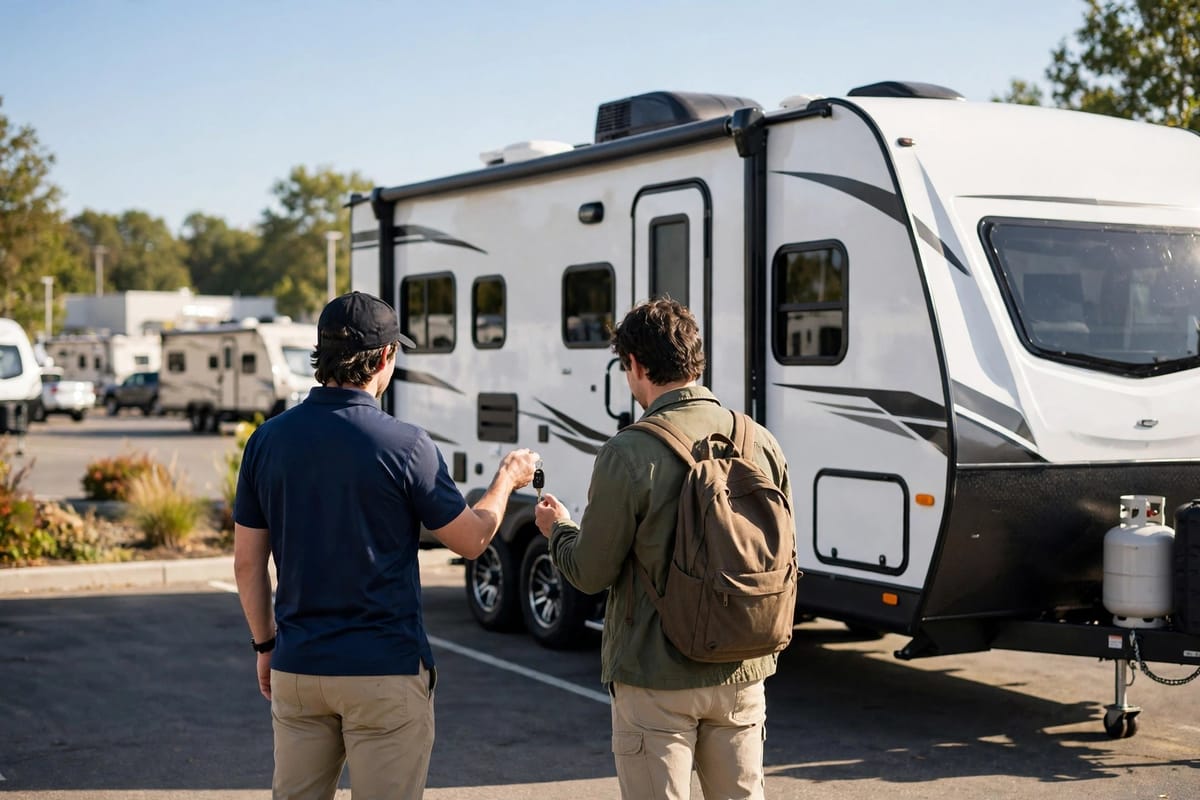
RV consignment sits in the middle of the selling spectrum: more hands-off than a private sale, more profitable than a dealer cash offer. You keep ownership of your RV while a dealer markets it, shows it, handles the financing and paperwork, and takes a commission when it sells. For the right seller, it is the sweet spot. For the wrong seller, it is an expensive way to learn contract law.
This guide explains how consignment actually works, what dealers typically charge, the contract clauses that matter, and the math to decide whether consignment beats selling it yourself.
How RV Consignment Works
The concept is simple: you deliver your RV to a dealership, sign a consignment agreement, and the dealer sells it on your behalf. While it is consigned, you still own the RV and remain financially responsible for it — the loan payments, the insurance, and anything that happens to it on the lot.
Here is the typical sequence:
- Appraisal and agreement. The dealer inspects your RV, and you agree on an asking price (or price range) and the commission structure. You sign a consignment contract with a defined term.
- Prep and marketing. The dealer details the RV, photographs it, and lists it on their website and third-party marketplaces. Their sales staff shows it to walk-in and online buyers, offers financing, and accepts trade-ins — things a private seller cannot do.
- Offers and negotiation. When offers come in, the dealer presents them to you (under a good contract) or negotiates within agreed authority. You approve the final sale price.
- Closing and payout. The dealer handles the paperwork, lien payoff, and title transfer, then sends you the sale proceeds minus their commission and any agreed fees.
The dealer's advantages are real: professional presentation, foot traffic, financing for buyers, and staff whose full-time job is closing deals. The question is always what those advantages cost you.
What RV Consignment Typically Costs
Consignment pricing has two common structures, and you should understand both before you sign anything.
Flat percentage commission. The dealer takes an agreed percentage of the final sale price. Industry reporting puts typical commissions in the roughly 10 to 15 percent range at standard dealerships, with the broader market spanning about 8 to 25 percent depending on the dealer, the RV's value, and the services included. On a $60,000 sale, a 12 percent commission is $7,200 out of your proceeds.
Target-price (net-to-you) model. You and the dealer agree on a target price — say $55,000 — and the dealer keeps everything above it as commission. If the RV sells for $60,000, the dealer keeps $5,000. This aligns incentives toward a higher sale price, but only if the target was set fairly.
Beyond the commission, watch for stacked fees that live in the paperwork rather than the pitch: inspection or appraisal fees, marketing or advertising fees, monthly storage or lot fees if the unit sits unsold, detailing and reconditioning billed to you, and documentation fees at closing. Any single fee may be reasonable; the pattern to watch is a low headline commission paired with fees that add up to the same total.
Consignment vs Private Sale: The Math
Run your actual numbers before deciding. Here is a realistic comparison on a $60,000 RV:
| Private sale | Consignment (12%) | Dealer cash offer | |
|---|---|---|---|
| Sale price | $60,000 | $60,000 | ~$48,000–$52,000 |
| Commission/fees | ~$0–$300 (listing, detailing) | ~$7,200 + possible fees | $0 (built into low offer) |
| Your net | ~$59,700 | ~$52,000–$53,000 | ~$48,000–$52,000 |
| Your time | High (showings, calls, paperwork) | Low | Minimal |
| Typical timeline | Weeks to months | 1–3 months on contract | Days |
Consignment earns its keep when the dealer's reach and financing get you a higher sale price than you could achieve alone, or when your time is worth more than the commission. It loses when the RV would have sold quickly at the same price without the middleman. If your RV is a desirable model in good condition, price the private-sale path honestly before signing — the gap is often smaller than dealers suggest. For a broader comparison of every selling path, see where to sell your RV.
The Contract Clauses That Actually Matter
The consignment agreement is where sellers get surprised. Read these five clauses before you sign:
Exclusivity period. Most contracts run 30 to 90 days, and during that window you typically cannot sell the RV yourself or list it anywhere else — even to a neighbor who has wanted it for years. Some contracts still owe the dealer commission if you find the buyer yourself during the term. Check the renewal language too: many agreements auto-renew unless you cancel in writing.
Insurance while it sits on the lot. Do not assume the dealer covers your RV. Many contracts make insurance the owner's responsibility, and a standard personal RV policy may not cover a unit consigned for commercial sale — some insurers require a specific endorsement. Get in writing who covers theft, hail, lot damage, and test-drive incidents.
Storage, prep, and reconditioning. Some dealers store consigned units free; others charge monthly after a grace period. Nearly all will recommend detailing or repairs to make the unit retail-ready — at your expense. Reasonable prep helps the sale, but require written approval for any charge above a dollar amount you set.
What happens if it does not sell. This is the clause sellers skip and regret. Do you owe marketing, storage, or prep fees even if the RV never sells? Can you retrieve it mid-contract, and is there an early-termination fee? A contract where an unsold RV still costs you hundreds in fees is not a no-risk arrangement.
Price authority. Who approves a price drop? Who accepts an offer? Insist on language requiring your written approval for any sale below an agreed floor. Remember the incentive problem: a dealer earning 12 percent gives up little commission by knocking a couple thousand off your price to close a deal faster. You absorb almost all of it.
Red Flags in a Consignment Dealer
Walk away — or at least slow down — when you see these:
- Vague commission math. If the dealer cannot show you, in writing, exactly how the commission and every fee are calculated, the total will be higher than the pitch.
- Pressure to sign today. A legitimate consignment offer is good next week too. High-pressure closings protect the dealer, not you.
- No price-drop authority for you. If the contract lets the dealer discount your RV without your sign-off, your floor price is fiction.
- The lot is full of stale consignment units. Drive the lot. Rows of dusty consignment RVs with faded price signs tell you how actively the dealer markets other people's inventory.
- No references from past consignors. Ask for two or three past consignment sellers you can call. Hesitation is an answer.
- You pay even if it never sells. Marketing and storage fees that accrue with no sale transfer all the risk to you.
When Consignment Is Worth It — and When It Is Not
Consignment tends to be worth it when: you have no time for showings and inquiries; your RV benefits from dealer financing (higher-priced motorhomes especially, where most buyers finance); you are uncomfortable negotiating; or the dealer genuinely moves a lot of consignment inventory in your RV's category.
Sell it yourself when: your RV is a high-demand model that will sell quickly at market price; you are comfortable showing it and handling paperwork; or the commission exceeds what your time is actually worth. A clean, fairly priced travel trailer or camper van on a good marketplace often sells in weeks — paying 12 percent to save a few weekends rarely pencils out.
Take the cash offer when: you need money this week, the RV needs work you do not want to fund, or you are trading up and the tax and convenience math favors the dealer. Just know you are trading dollars for speed.
Questions to Ask a Consignment Dealer Before Signing
Take this list to every dealer interview. Their answers — and their comfort answering — tell you everything:
- What is the exact commission percentage, and what fees exist beyond it? Show me the math on a $50,000 sale.
- How long is the exclusivity period, and does it auto-renew?
- Can I sell the RV myself during the contract, and what do I owe you if I do?
- Who insures the RV on your lot — you or me? Show me where the contract says so.
- Who approves price drops and offers? Will you put "seller's written approval required below $X" in the contract?
- What are the storage, prep, and detailing charges if the RV does not sell?
- Can I end the contract early, and what does that cost?
- How many consignment units did you sell last quarter, and what is your average days-on-lot?
- Can I speak with two sellers who consigned with you recently?
A dealer who answers crisply and hands you references is a candidate. A dealer who waves away questions 1 through 7 is telling you the answers are bad.
What is a typical RV consignment fee?
How long does RV consignment take?
Do I need special insurance while my RV is on consignment?
Can I still use my RV while it is on consignment?
Is consignment better than trading in my RV?
Ready to Sell Without the Middleman?
Consignment works for some sellers — but if your RV is clean, fairly priced, and in a high-demand category, you may keep thousands more by selling it yourself on a marketplace built for RV buyers.
List your RV on RV Matcher and reach serious buyers directly, without giving up a commission. Not sure what your RV is worth yet? Check your RV's value first, then decide which selling path earns you the most.