RV Consignment: How It Works, What Dealers Really Charge, and When It Costs You Thousands

The Consignment Promise vs. Financial Reality
Dealership consignment is frequently pitched as an easy compromise: higher returns than an immediate trade-in with less effort than selling privately. You drop the rig off at a dealership lot, let their sales team handle showings, and wait for a check.
However, that convenience comes at a steep price. Between standard commissions (10% to 15%), prep charges, storage fees, and dealer negotiation incentives, consigning an RV routinely costs owners $5,000 to $10,000+ on a mid-priced rig compared to selling it directly.
Understanding consignment fee structures, contract clauses, and the underlying conflict of interest with dealer-owned inventory is critical before signing an agreement.
How RV Consignment Operates
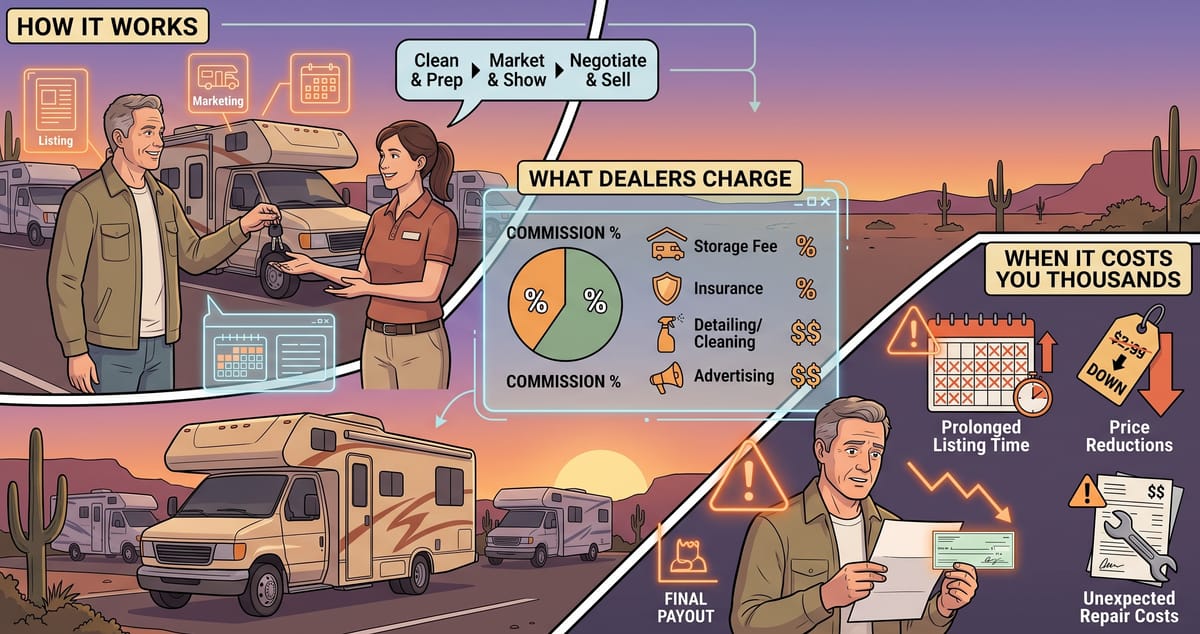
In a consignment transaction, you retain legal title while the dealership takes physical custody of your RV to market and sell it on your behalf. The dealer stores the unit, photographs it, handles listings and buyer inquiries, conducts walkthroughs, assists buyers with on-site financing, and processes DMV paperwork.
When the unit sells, the dealer deducts their commission and associated administrative fees before issuing your payout.
While dealerships provide physical foot traffic and financing tools for loan-dependent buyers, you surrender pricing control, lose personal access to your RV during the contract term, and finance every dollar of the dealer's overhead directly out of your vehicle equity.
4 Common Consignment Pricing Models
- Percentage Commission (Most Common): The dealer takes a fixed cut of the gross sale price, typically 10% to 15% (occasionally 8% to 12% on higher-end coaches). On a $60,000 fifth wheel, a 12% commission removes $7,200 before secondary fees.
- Flat Fee Agreement: A fixed dollar charge (e.g., $3,000 to $5,000) regardless of the sale price. This structure benefits sellers of high-value luxury coaches ($150,000+) but heavily penalizes sellers of entry-level travel trailers.
- Tiered / Split Structure: A hybrid rate (such as 15% on the first $30,000 and 10% on the remainder). These schedules are often designed to look lower upfront while capturing similar total margins.
- "Net Price" / Guaranteed Minimum: You agree to a fixed dollar floor (e.g., $50,000), and the dealer keeps 100% of the proceeds above that number. This creates a severe misalignment: dealers are incentivized to set your floor artificially low and pocket thousands in retail upside without disclosing the final transaction price.
Secondary Fees Often Buried in the Fine Print:
- Initial pre-listing mechanical inspection / appraisal: $150–$350
- Online marketing & listing syndication: $100–$500
- Monthly lot storage fees (often applied after a 30-day grace period): $75–$250/month
- Mandatory detailing / make-ready wash: $200–$600
- Document preparation and dealer transfer fees: $100–$300
5 Critical Contract Clauses to Review Before Signing
- 1. Exclusivity & Locked Terms (30–90 Days): Standard contracts prohibit you from selling the RV privately during the term. Many agreements state that if you find your own buyer or sell to a family member while the contract is active, you still owe the dealer their full commission. Ensure auto-renewal clauses are crossed out.
- 2. Lot Insurance & Liability: Never assume the dealer’s commercial garage policy protects your RV. Many contracts explicitly state the vehicle remains the owner's responsibility. Standard personal auto/RV policies often exclude vehicles consigned for commercial sale unless a specific consignment endorsement is added. Confirm in writing who covers lot hail damage, vandalism, fire, and test-drive collisions.
- 3. Reconditioning Authorization Limits: Most dealers recommend resealing roofs, servicing slide-outs, or replacing house batteries to make the unit "retail ready." Require written pre-approval for any repair or maintenance item exceeding $100.
- 4. No-Sale Penalties & Retrieval Fees: Check what happens if the contract expires without a sale. Unfavorable agreements still bill you for detailing, storage, marketing, and early-termination fees before releasing your keys.
- 5. Price Reduction Authority: Insist on written approval for any price drop. A salesperson earning a 10% commission loses only $100 by dropping your asking price by $1,000 to close a quick sale, while you absorb the full $900 loss.
Financial Breakdown: Selling a $60,000 Fifth Wheel
| Financial Line Item | Instant Dealer Trade-In | Dealer Consignment | Private Sale on RV Matcher |
| Gross Agreed Price | $48,000–$52,000 (Wholesale) | $57,500 (Negotiated down) | $58,500–$60,000 (Retail Market) |
| Commission Deducted | $0 | −$6,900 (12% average) | $0 |
| Prep, Detail & Doc Fees | $0 | −$500–$900 | $0 |
| Direct Seller Costs | $0 | $0 | −$150–$300 (Detailing/Photos) |
| Total Net Proceeds to You | $48,000–$52,000 | ~$49,700–$50,200 | ~$58,200–$59,700 |
| Closing Timeline | Instant (Same Day) | 30 to 120+ Days | 14 to 45 Days |
Once commissions and administrative fees are deducted, consignment net proceeds often land within a couple thousand dollars of an immediate wholesale trade-in—without the benefit of a same-day payout. By contrast, a direct sale captures $8,000 to $10,000+ in additional equity.
When Dealership Consignment Makes Practical Sense
Consignment carries significant costs, but it can be a viable strategy in specific situations:
- Long-Distance / Remote Ownership: You live far away from where the RV is stored (such as an inherited unit out of state or a snowbird rig left across the country) and cannot physically manage showings.
- Ultra-Luxury Coaches ($200,000+): High-end Class A diesel pushers require specialized commercial financing, extended warranty options, and complex trade-in handling that private buyers struggle to coordinate independently.
- Strict Time Constraints: If your time is worth more than the $7,000–$10,000 private-party premium, delegating the entire transaction can be a calculated lifestyle choice.
Consignment Dealership Red Flags
- Unverified Lot Insurance: Inability to provide written confirmation of dealer liability coverage for lot damage, theft, or test drives.
- Pressure Toward Net-Pricing Deals: Insisting on a low guaranteed minimum price without agreeing to disclose the final buyer's actual purchase contract.
- Aging Consignment Inventory: A lot packed with faded, weather-worn consignment units sitting on flat tires indicates poor sales velocity and potential long-term storage fees.
- Auto-Renewing Contracts: Agreements that automatically lock your unit into subsequent 90-day terms unless terminated via certified mail weeks in advance.
6 Questions to Ask Before Signing a Consignment Agreement
- What is the total, all-in cost (commission plus detailing, inspection, marketing, and document fees) if the rig sells at full asking price?
- What exact balance do I owe if the unit does not sell within 60 days and I choose to retrieve it?
- Does your dealership garage policy primary-cover physical damage, storm impact, and test-drive accidents while the RV is in your care?
- What was the average days-on-lot and final selling price for the last three comparable units you sold?
- Do you require my explicit written consent before accepting any offer or discounting the list price?
- Will I receive a copy of the final buyer’s signed purchase agreement showing the exact closing price?
Frequently Asked Questions
What commission percentage do RV consignment dealers take?
Most dealers charge between 10% and 15% of the final selling price. On a $50,000 camper, that amounts to $5,000 to $7,500, not including secondary preparation, marketing, or administrative fees.
Can I sell my RV myself while it is listed on a consignment lot?
Generally, no. Standard consignment agreements include an exclusivity clause granting the dealer sole selling rights for 30 to 90 days. If you find a private buyer independently during that period, the contract typically still obligates you to pay the dealer's full commission.
Who pays for insurance during consignment?
In most cases, the vehicle owner is responsible for maintaining active insurance. Because standard personal policies frequently exclude commercial sales lots, you must contact your insurance provider to add a specific consignment endorsement.
What is a net-price consignment agreement?
A net-price agreement guarantees the seller a minimum dollar floor, allowing the dealer to keep all profit above that threshold. This structure incentivizes the dealership to suppress the seller's valuation expectations while keeping full retail upside.
Handing over 10% to 15% of your vehicle's value is an expensive solution for tasks you can handle in a few hours. List your camper or motorhome on RV Matcher to reach thousands of verified buyers directly, retain total control over your pricing and negotiations, and keep 100% of your sale equity.