RV Towing Capacity Guide: How to Know What Your Vehicle Can Tow (2026)
RV towing capacity explained in plain English: GVWR, GCWR, payload, tongue weight, the 80% rule, typical tow ratings by vehicle, and the 7 towing mistakes that catch buyers off guard.


"I can tow 11,000 pounds, so a 9,000-pound trailer is fine — right?" This is the most expensive misunderstanding in RV buying. That advertised tow rating assumes an empty truck and a 150-pound driver. Real-world towing capacity is almost always lower — and the number that stops most setups isn't the tow rating at all. It's payload.
This guide explains RV towing capacity in plain English: the six ratings that matter, how to do the math on your specific truck and trailer, the 80% safety rule, and the mistakes that put overloaded rigs on the highway every weekend. Read this before you buy the trailer — it's much cheaper than buying the wrong one.
The 6 Weight Ratings That Determine What You Can Tow
Every tow vehicle and trailer carries a set of ratings. Learn these six and you understand towing; ignore them and you're guessing with 10,000 pounds behind you.
GVWR — Gross Vehicle Weight Rating
The maximum your tow vehicle alone can weigh when fully loaded: the truck plus fuel, passengers, cargo, pets, the hitch, and the trailer's tongue weight pressing down on it. This is the rating most towers exceed first.
GCWR — Gross Combined Weight Rating
The maximum your truck and trailer can weigh together. This is the "big picture" limit — even if the truck and trailer are each under their own GVWR, the combination can still exceed GCWR.
Payload capacity
GVWR minus the truck's curb weight — the actual capacity left for everything you add: people, gear, the hitch, and tongue weight. Payload is the binding constraint on most half-ton trucks. A truck rated to tow 11,000 lbs might have only 1,500 lbs of payload, and one heavy trailer can eat most of that in tongue weight alone.
Curb weight
What the vehicle weighs empty from the factory — full fluids, no passengers or cargo. Your starting point for every calculation.
Tongue weight / pin weight
The downward force the trailer puts on the hitch. For travel trailers, plan on 10–15% of the loaded trailer weight (12–13% is the sweet spot for sway control; under 10% invites dangerous sway). For fifth wheels, plan on 15–25% (around 20% is a good planning number). This weight counts against your truck's payload — it's the number that breaks most "my truck can tow it" assumptions.
Max tow rating (advertised towing capacity)
The manufacturer's headline number — and the least useful for real planning. It's calculated under ideal conditions: base truck, minimal options, one small driver, no cargo. Treat it as a ceiling, not a target.
How to Calculate Your Real Towing Capacity: Step by Step
Forget the brochure. Here's the math that matters, using your actual numbers:
Step 1: Find your truck's real numbers. Open the driver's door and read the jamb sticker: GVWR, front and rear GAWR (gross axle weight ratings), and the payload line ("the combined weight of occupants and cargo should never exceed X"). Get the GCWR and max tow rating from your owner's manual or the manufacturer's towing guide for your exact engine, cab, and axle ratio.
Step 2: Weigh your loaded truck. The only honest number comes from a scale. Load the truck as you would for a trip — family, pets, gear, full fuel — and weigh it. Subtract that from your GVWR. What's left is your available payload, and it's almost always less than you think.
Step 3: Estimate the trailer's real weight. Ignore "dry weight" (UVW) — it's the trailer as it left the factory, before batteries, propane, water, food, and gear. A realistic rule: loaded trailer weight ≈ UVW + 800–1,500 lbs (more for toy haulers and full-timers). For safety planning, many experienced towers just use the trailer's GVWR.
Step 4: Calculate tongue or pin weight. Take 12–13% of the loaded weight for a travel trailer, ~20% for a fifth wheel. Add the hitch hardware (roughly 75–125 lbs for a weight-distribution hitch, 150–250 lbs for a fifth-wheel hitch).
Step 5: Run the payload equation. This is the one that matters most:
Available payload ≥ passengers + pets + cargo + hitch hardware + tongue/pin weight
If that sum exceeds your payload sticker, you're overweight — even if you're thousands of pounds under the advertised tow rating.
Step 6: Check the combined weight. Loaded truck weight + loaded trailer weight must stay under GCWR. Then check axle loads: heavy tongue weight overloads the rear axle first, so compare against your rear GAWR.
Worked example. A half-ton with 1,700 lbs of payload, carrying two adults (350 lbs), gear (250 lbs), and a weight-distribution hitch (100 lbs) has 1,000 lbs left for tongue weight. At 12% tongue weight, that supports a loaded trailer of roughly 8,300 lbs — even if the advertised tow rating is 11,000+. The payload math, not the brochure, sets the real limit.
The 80% Rule: Why Experienced Towers Leave a Margin
Ask around any campground and you'll hear the 80% rule: don't tow more than 80% of your vehicle's rated capacity. It's not a law — it's wisdom. That 20% margin absorbs what ratings don't account for: mountain grades, crosswinds, emergency braking, and the extra gear you always end up bringing.
Staying comfortably under your limits means better handling, shorter stopping distances, less strain on your transmission and brakes, and a far more relaxed drive. Towing at 100% of capacity is legal but miserable; towing at 75–80% is the difference between white knuckles and enjoying the trip.
Typical Tow Ratings by Vehicle Class (Approximate)
These are rough, real-world ranges — actual ratings vary widely by engine, drivetrain, cab configuration, and axle ratio. Always verify your specific vehicle's ratings:
| Vehicle class | Typical max tow rating (approx.) | Realistic RV match |
|---|---|---|
| Midsize SUV (e.g., 4Runner-class) | 3,500–5,000 lbs | Pop-ups, teardrops, small single-axle trailers |
| Full-size SUV (e.g., Tahoe/Expedition-class) | 7,000–9,500 lbs | Mid-size travel trailers |
| Midsize pickup | 5,000–7,700 lbs | Small to mid-size travel trailers |
| Half-ton pickup (1500-class) | 8,000–13,000 lbs | Most travel trailers; smaller fifth wheels |
| Heavy-duty pickup (2500/3500-class) | 14,000–35,000+ lbs | Large fifth wheels, big toy haulers |
Two warnings. First, the top of each range usually requires the max-tow configuration — the truck on the dealer lot may rate thousands of pounds lower. Second, and more important: the tow rating is not your limit; payload is. A half-ton "rated for 12,000 lbs" with 1,400 lbs of payload cannot safely tow a 12,000-lb travel trailer, because the ~1,450-lb tongue weight alone exceeds payload before you add a single passenger. Run the payload equation every time.
If your current vehicle can't safely handle the trailer you want, our guide to the best lightweight travel trailers is built for exactly this situation — great campers that half-tons and midsize SUVs tow comfortably.
Travel Trailer vs. Fifth Wheel: Different Hitches, Different Demands
The two towable RV types load your truck very differently:
Travel trailers connect at the rear bumper. They're more prone to sway, which is why a weight-distribution hitch with sway control is strongly recommended for anything over roughly 5,000 lbs. Tongue weight runs 10–15% of trailer weight. The upside: you keep your truck bed free, and almost any properly rated truck can tow one.
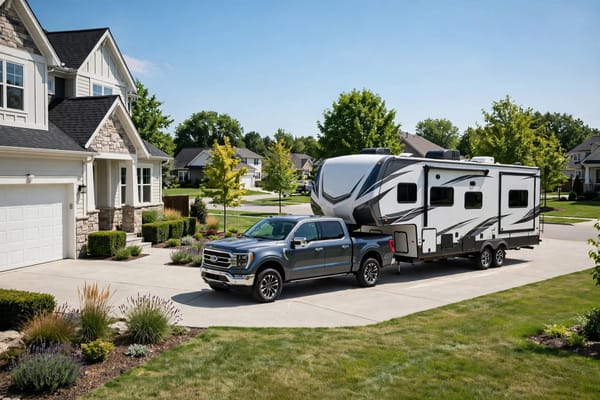
Fifth wheels connect to a hitch in the truck bed, over the rear axle. They're inherently more stable — the pivot point over the axle nearly eliminates sway. But pin weight runs 15–25% of trailer weight (a 12,000-lb fifth wheel puts roughly 2,400 lbs in the bed), which demands a heavy-duty truck for all but the smallest models. You also lose most of your bed to the hitch.
Shopping big? See our best toy haulers guide — but check your payload first, because toy haulers are among the heaviest trailers per foot.
7 Towing Mistakes That Catch Buyers Off Guard
- Trusting dry weight. UVW excludes propane, batteries, water (8.3 lbs per gallon — a 40-gallon tank adds over 330 lbs), food, and gear. Plan on the loaded weight, not the brochure weight.
- Forgetting payload. The #1 error. The tow rating says yes while the payload sticker says no — and the payload sticker is the one that governs safety.
- Ignoring tongue weight percentage. Too little (under 10%) causes trailer sway — the most dangerous towing failure. Too much overloads the rear axle. Aim for 12–13% on travel trailers, ~20% on fifth wheels.
- Skipping the weight-distribution hitch. On heavier travel trailers, a WDH isn't optional equipment — it restores steering weight to the front axle and adds sway control.
- Overlooking tires. Your tires must be rated for your actual axle weights at proper inflation. Under-rated or under-inflated tires are the leading cause of blowouts, and blowouts cause a disproportionate share of towing accidents. Check the DOT date code — tires age out around 5–7 years regardless of tread.
- Never weighing the rig. A CAT scale visit costs roughly $13 and takes ten minutes. Weigh the truck alone, then truck and trailer together, and compare every number to your ratings. It's the best safety money in RVing.
- Forgetting the "other" weights. The generator in the bed, the firewood, the full freshwater tank "just in case" — it all counts. Weigh loaded for a real trip, not empty.
How do I know if my truck can tow a specific RV?
What is the 80% towing rule?
Does tow rating or payload matter more?
Can a half-ton truck tow a fifth wheel?
Should I weigh my RV and truck on a CAT scale?
Find an RV Your Vehicle Can Actually Tow
Now that you know your real numbers, shop with confidence. Browse RVs with full specs — weights, lengths, and classes — and filter for the trailers your truck handles comfortably, not just the ones the brochure says it can pull.
Browse RVs for sale on RV Matcher — compare real weights and specs across thousands of listings to find the right match for your tow vehicle.