Understanding RV Electrical Systems: The Complete Beginner’s Guide to Volts, Amps, and Watts

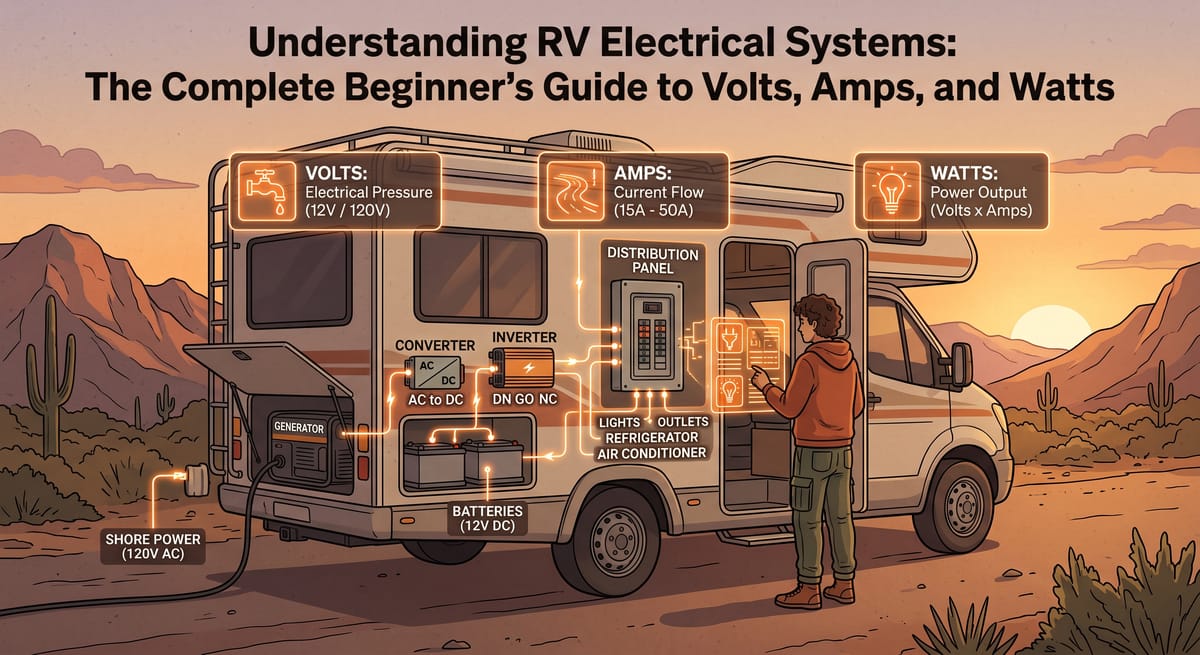
Navigating an RV’s electrical system can be intimidating for new and experienced RVers alike. Understanding how power flows through your camper is essential for preventing tripped breakers, protecting delicate electronics, and managing off-grid battery reserves.
The Core Basics: The Water Hose Analogy
The clearest way to understand electricity without an engineering degree is the classic plumbing analogy:
- Voltage (Volts / V): The electrical pressure pushing the current through the wires (like water pressure in a hose).
- Current (Amps / A): The rate of flow or volume of electrical current moving through the circuit.
- Power (Watts / W): The total amount of work performed by the electrical flow.
Formula: Watts = Volts × Amps
If an appliance pulls 10 amps on a standard 120-volt line, it consumes 1,200 watts ($120 \times 10 = 1,200$). Calculating wattage helps you determine how many appliances can run simultaneously without overloading your system.
12-Volt DC vs. 120-Volt AC: Your Rig’s Two Power Systems
RVs do not run on a single electrical circuit; they rely on two distinct systems working side by side.
1. The 12-Volt DC System (Direct Current)
- Power Source: Onboard house batteries, solar systems, or shore power converted via a power converter.
- Loads Powered: Interior LED lighting, water pump, furnace fan, slide-out motors, leveling jacks, and control boards for water heaters and absorption refrigerators.
- Key Characteristic: Operates independently of campground hookups, keeping vital systems active while boondocking.
2. The 120-Volt AC System (Alternating Current)
- Power Source: Shore power pedestal, onboard/portable generator, or an inverter drawing from battery banks.
- Loads Powered: Air conditioners, microwaves, residential refrigerators, standard household wall outlets, and electric water heating elements.
- Key Characteristic: Requires standard household-level voltage to operate high-draw equipment.
Inverter vs. Converter:A Converter turns 120V AC shore power into 12V DC power to charge batteries and run 12V gear.An Inverter turns 12V DC battery power into 120V AC power to run household appliances when disconnected from shore power.
30-Amp vs. 50-Amp RV Shore Power
The difference between 30-amp and 50-amp service is not merely an extra 20 amps—it is more than triple the overall usable power.
| Feature | 30-Amp RV Service | 50-Amp RV Service |
| Plug Configuration | 3-prong plug | 4-prong plug |
| Electrical Feeds | 1 hot leg (120V @ 30A) | 2 hot legs (120V @ 50A each) |
| Total Max Capacity | 3,600 Watts | 12,000 Watts |
| Typical Rig Types | Camper vans, small travel trailers | Large fifth wheels, Class A motorhomes |
| A/C Capacity | Typically 1 Air Conditioner | 2 to 3 Air Conditioners |
Managing Power on 30-Amp Service
With a maximum limit of 3,600 watts, running multiple heating-element or motor-driven appliances at once will trip the main pedestal breaker. Running an air conditioner (1,500W) alongside a microwave (1,200W) and an electric water heater (1,200W) totals 3,900W, which exceeds system capacity.
Appliance Power Consumption: Running vs. Surge Watts
Appliances with compressors or electric motors (like rooftop A/C units and refrigerators) require a spike of surge wattage to start up, which settles down to a lower running wattage.
- Rooftop Air Conditioner (13.5k BTU): 2,800–3,000W Surge | 1,300–1,600W Running
- Microwave: 1,000–1,500W
- Electric Coffee Maker: 800–1,200W
- Hair Dryer: 1,200–1,800W
- Electric Space Heater: 750–1,500W
- Laptop Charger: 60–100W
- 12V LED Light: 5–10W
Always factor in startup spikes when sizing portable generators or inverters.
RV Battery Storage: Amp-Hours vs. Watt-Hours
House batteries store potential energy measured in Amp-Hours (Ah):
- A 100Ah, 12V Lead-Acid/AGM Battery provides roughly 1,200 Watt-hours of nominal capacity, but only 50% (600Wh / 50Ah) is usable without damaging the chemistry.
- A 100Ah, 12V Lithium (LiFePO4) Battery provides roughly 1,280 Watt-hours, with 80% to 100% (1,000–1,280Wh) of safe usable capacity.
High-draw 120V appliances routed through an inverter will drain battery banks rapidly. Running a 1,200-watt microwave for 10 minutes consumes around 200 watt-hours—an easy load for lithium banks, but a significant hit to single lead-acid setups.
Adapters, Dogbones, and Shore Power Safety
Electrical adapter plugs (commonly called "dogbones") allow you to connect between mismatched plug styles:
- 50A RV to 30A Pedestal: The RV receives power, but capacity drops from 12,000W down to the pedestal's 3,600W limit.
- 30A RV to 50A Pedestal: The RV only draws the power it requires. The onboard 30A breaker box continues to protect internal circuits from overcurrent.
Critical Safety Hardware
- Use an EMS (Electrical Management System): Unlike basic surge protectors, an EMS cuts power during sustained low voltage (brownouts below 104V), open neutrals, reverse polarity, and sudden voltage spikes.
- Inspect Plugs and Cords Regularly: Discoloration, melted casing, or loose fitments cause high electrical resistance, generating heat and posing fire hazards.
- Know When to Call a Certified Tech: Persistent breaker trips, burning plastic odors, or inverter fault codes indicate underlying wiring issues that require professional RV diagnostic tools.
The best place to Buy or Sell an RV