How to Write an RV Listing That Actually Sells (With Examples)
Learn how to write an RV for-sale listing that gets clicks: headline formulas, a description template, spec table must-haves, and a before/after example.

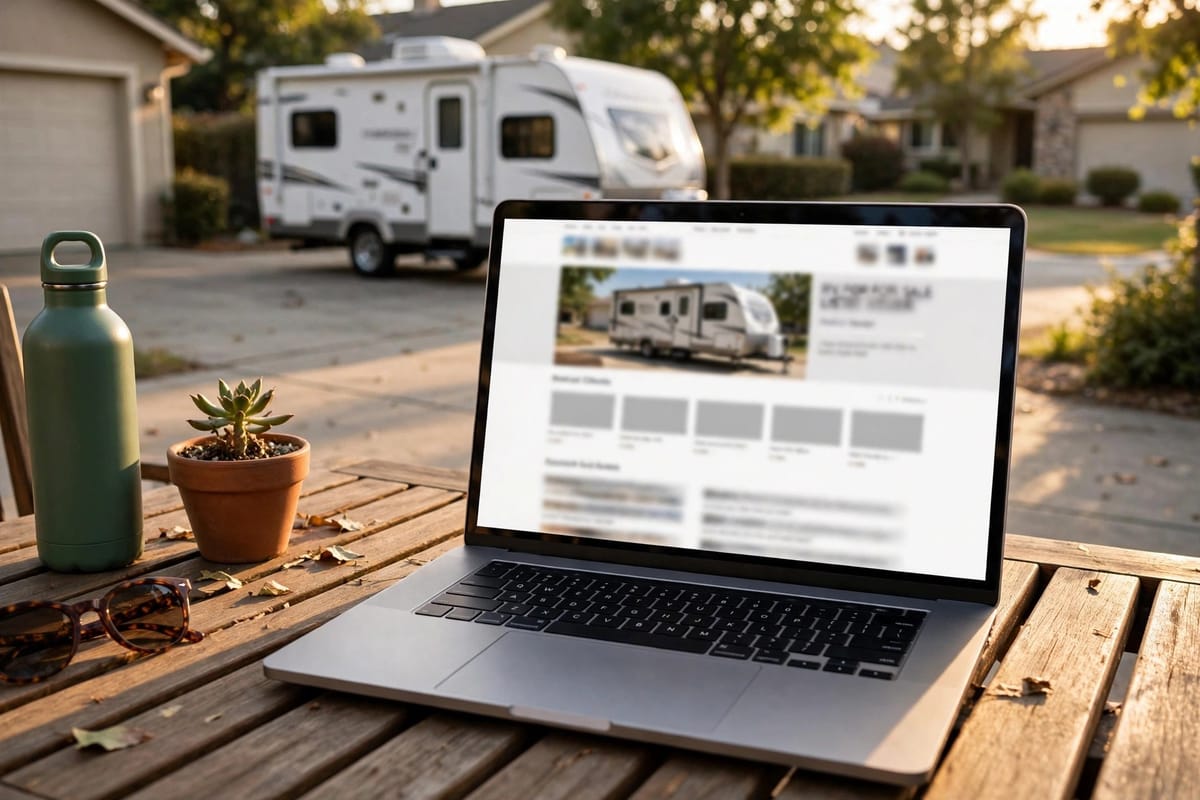
Most RV listings fail before the photos even load. The headline is "Nice camper for sale," the description is three sentences, the specs are missing, and the price says "call." Meanwhile the RV next to it in the search results has a crisp headline, a complete spec table, and a description that answers every question — guess which one gets the inquiry.
Writing a listing is a sales skill, and it is learnable. This guide gives you the headline formulas, the description template, the spec table buyers expect, the pricing psychology that gets clicks, and a real before-and-after example you can copy.
The Headline: Your 60-Character Sales Pitch
Your headline is the only part of your listing most shoppers read before deciding to click. Marketplace search results show year, make, model, price, location, and one thumbnail — your headline text has to earn the tap.
The formula that works: Year + Make + Model + Floorplan + Mileage (if motorized) + One Differentiator.
Good examples:
- "2022 Grand Design Reflection 150 Series 260RD — Bunkhouse, Solar, Like New"
- "2020 Winnebago Travato 59G Class B — 38k Miles, Lithium Batteries"
- "2019 Airstream Flying Cloud 25FB — Original Owner, Stored Indoors"
Each one tells a buyer, in a single line, exactly what the RV is and why this particular one deserves a click. The differentiator — solar, original owner, stored indoors — is doing the heavy lifting.
Headline mistakes that cost clicks:
- ALL CAPS or excessive punctuation ("MUST SEE!!! PRICED TO SELL!!!") — reads as desperation or a scam.
- Vague nouns ("Nice camper," "RV for sale") — invisible in search.
- Missing year/make/model — buyers filter by these; without them you do not appear.
- Leading with the price drop ("REDUCED!!!") — discount-first framing attracts lowballers, not buyers.
Marketplace data consistently shows that complete listings with prices get dramatically more engagement than those without — one major marketplace reports priced listings earning many times the clicks of unpriced ones. Always show the price.
The Spec Table: What Buyers Expect to Find
Before a buyer reads a single sentence of your story, they scan for facts. Put the essentials in a clean table or bulleted spec block at the top of your description so scanners get what they need in ten seconds.
Every listing must include:
| Spec | Why it matters |
|---|---|
| Year, make, model, floorplan/trim | The identity — buyers search and filter on these |
| Mileage (motorized) or length (towable) | The two most-filtered specs in RV search |
| Sleeps / sleeping configuration | Families filter hard on this |
| Slide-outs (count) | Major space and value factor |
| Dry weight / GVWR (towables) | Buyers must match their tow vehicle |
| Tank capacities (fresh/grey/black) | Boondockers care deeply |
| Generator make, model, hours | Affects value by thousands on motorhomes |
| Tire age (DOT date codes) | Safety item every informed buyer asks about |
| Title status | Clear, lien, rebuilt — disclose upfront |
Strong additions: solar wattage and battery type, air conditioner count and BTU, awning length and type, hitch type and weight distribution setup (towables), recent major service with dates, warranty transferability.
If you do not know a spec, look it up — the manufacturer's brochure for your model year is usually findable online. "I don't know" on basic specs reads as "I don't maintain this RV."
The Description Template: Story Plus Substance
After the spec block, write 200 to 400 words that do three jobs: establish credibility, describe the RV honestly, and make the buyer picture themselves using it. Here is a template that works:
Paragraph 1 — Who you are and why you are selling (2–3 sentences). "We're the original owners, selling because we've upgraded to a fifth wheel for full-timing." Honest, human, and it pre-answers the buyer's first suspicion.
Paragraph 2 — Condition and maintenance (3–5 sentences). Lead with the strongest proof: "Always stored under cover, serviced annually at [dealer], new tires in 2024, roof resealed last spring." Then disclose the minor flaws: "Small scuff on the rear bumper, one cabinet latch replaced." Disclosing small flaws builds trust that makes buyers believe the big claims.
Paragraph 3 — How you have used it and the upgrades (3–5 sentences). "Weekend campers, never full-timed, non-smoking, no pets. Added 400W solar with lithium batteries, MaxxAir vent covers, and a weight-distribution hitch included in the sale." Usage history tells buyers how hard a life the RV has lived.
Paragraph 4 — The lifestyle close (2–3 sentences). "This floorplan's rear living area is perfect for morning coffee with a view — we've watched sunrises over six national parks from those windows." You are selling the feeling, not just the fiberglass.
Final line — logistics. "Clear title in hand. Located in [City, State]. Available for showings evenings and weekends. Serious inquiries only, please."
That structure — credibility, condition, history, lifestyle, logistics — answers the buyer's questions in the order they ask them.
Pricing Psychology in the Listing
How you present the price shapes who inquires:
- Price at or just under a round number. $29,900 outperforms $30,000 in click-through, and $24,500 beats $24,999's odd precision on higher-ticket RVs where buyers round anyway.
- Show the price. Unpriced listings get a fraction of the inquiries. "Call for price" means "I'm embarrassed by the price" to most buyers.
- State your negotiation posture. "Priced at market — no lowball offers, please" filters time-wasters. "OBO" or "or best offer" increases inquiry volume when you need speed. Pick one deliberately.
- Do not narrate your price drops. Editing the price down quietly is fine; a headline screaming "REDUCED AGAIN!!!" trains buyers to wait for the next cut.
- Anchor with comparables, not your costs. "Priced below NADA average retail for quick sale" is persuasive. "I paid $45,000 and added $8,000 in upgrades" is irrelevant to the buyer — they are buying the RV, not your receipts.
- Revisit on a schedule, not on emotion. If inquiries are thin after two weeks, the market is telling you something. Check your comparables again, improve the weakest photos, and adjust the price once — deliberately — rather than bleeding it down in five anxious cuts. A single confident repricing beats a slow drip that trains buyers to wait.
For the full pricing method, see how to price your RV.
Before and After: The Same RV, Two Listings
Before — the listing that sits for months:
"2018 camper for sale. Good condition, everything works. Sleeps 6. $21,000 OBO. Text me."
Fourteen words. No make, no model, no length, no floorplan, no location, no photos mentioned, no reason to trust the seller. This listing is invisible in filtered search and unconvincing in unfiltered search.
After — the listing that sells in two weeks:
"2018 Jayco Jay Flight 26BH — Bunkhouse Travel Trailer, 30ft
Specs: 30'11" overall | Sleeps 8 (bunkhouse + queen + dinette) | 1 slide | Dry weight 5,845 lbs | 52-gal fresh water | Power awning | New tires 2024 (DOT 1224)
We're the second owners, selling because the kids outgrew bunkhouse camping. Always stored under a carport, winterized professionally every fall, and serviced at the dealer each spring — records available. Non-smoking, no pets. Upgrades: 200W solar panel, vent covers, and an Equal-i-zer hitch included.
The bunkhouse floorplan is the perfect family starter — the kids get their own space and the rear queen gives parents a real bedroom. We've done two weeks at Yellowstone and countless weekends in this trailer without a single issue.
One honest note: there's a small delamination spot (about 6 inches) on the front cap from a previous seal repair — sealed and stable, shown in photo 14. Priced with it in mind.
Clear title in hand. Located in Colorado Springs, CO. Available weekends. $21,900 — priced at NADA average retail for a quick, fair sale."
Same RV. The second version is findable (full identity in the headline), scannable (spec block), trustworthy (records, disclosure, specifics), and closable (title, location, availability, price rationale). That is the entire game.
Listing Red Flags to Avoid
While you are writing, make sure you are not accidentally signaling "scam" or "problem":
- Stock photos or no photos. Buyers assume the worst. Use 25+ real photos — our RV photo checklist shows every shot to take.
- Refusing to share the VIN. Legitimate sellers share it; buyers need it for history checks.
- "Selling for a friend" or "my uncle's RV." If you do not hold the title, say so plainly and explain the arrangement — vagueness here kills trust.
- Pressure tactics. "Three other buyers coming today" may be true, but in writing it reads as a scam script.
- Copy-pasted manufacturer brochure text as the whole description. Specs without your story tell the buyer nothing about THIS unit's condition.
How long should my RV listing description be?
Should I mention flaws in my listing?
Do keywords in my listing actually help it sell?
Should I include 'OBO' in my price?
How many photos should my listing have?
Ready to Put It All Together?
You now have the headline formula, the spec table, the description template, and the pricing psychology. The last step is putting your listing where serious RV buyers are already shopping.
Create your listing on RV Matcher — and if you are still unsure what to ask, check your RV's value first so your price lands with confidence on day one.